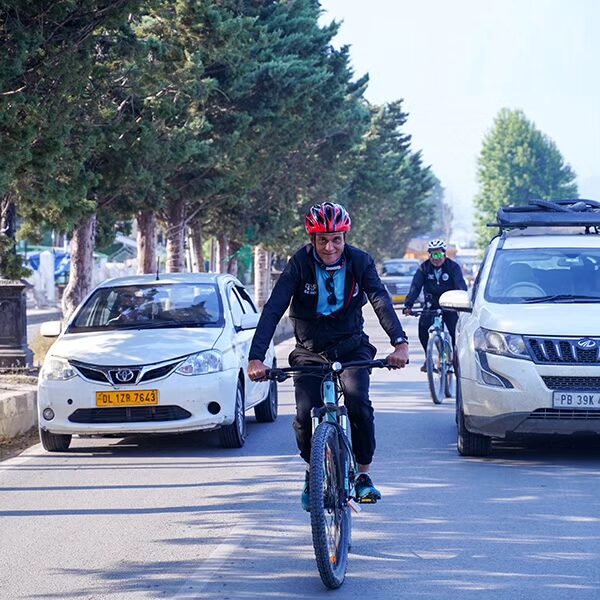
Cycling Safely in Mumbai
by Hansel D’Souza
How safe is cycling in Mumbai? This is the very first question people ask when they spot me in Lycra perched precariously on my roadie. I reply sardonically, “In 2023, over 150 pedestrians died while walking, 169 died on motorised 2-wheelers, but the number of cyclists – none that I know of !”
So does that mean Mumbai is perfectly safe for cyclists?!! Certainly not !! Mumbai is probably the least cycle-friendly megapolis in the world! So, how come the fatality count is so low?
From my personal experience as both a driver and a rider, my average speed by car is 7-10 kmph in peak hour traffic and around 25 kmph off peak hours. On a cycle, I do around 14 kmph in peak hours and around 25 kmph off peak hours. Either way, at these speeds, crashes are rarely fatal. Hence, the low fatality numbers.
And yet, only the brave or extremely foolish venture out pedalling in the city. Having been a hobby cyclist in Mumbai for the last 15 years, I have had my share of crashes and broken bones. Despite the metal plate and nine screws in my left wrist (Colle’s Comminuted Fracture), a torn ear lobe and stitches on the chin; I pedal on undeterred. The learnings from these episodes have been invaluable. Having seen cyclists brazenly risk their lives and limbs, I was prompted to share these lessons with the hope that a few more lives might be saved. For as my father would say, ” A wise man learns from others’ mistakes, a fool from his own!”.
Lesson 1: Pick the right time of day for a ride
Nobody knocks down a cyclist for sadistic pleasure. It’s always by accident. So, how does an accident occur? Most often, the cyclist is so inconspicuous on the road that to a truck driver, he’s almost invisible. To compound the lack of visibility is the lack of ambient light. My worst ever ride started at 7 pm and ended at 8 am the next morning. It was a Night BRM 200 km from Mumbai to Kamshet and back. I vowed never to ride at night again. It was on this ride that I discovered that rechargeable safety lights last just 2 hours. Batteries last slightly longer. For your front, rear, and helmet lights, you will need at least six fully charged lights for each of the three varieties. Add to that food and water, which are just not available at night, imagine your plight on an unsupported ride! That was the first and last night ride I ever did 10 years ago! I know a group of riders who choose to ride on the Western Express Highway at five in the morning !! That’s when trucks are speeding to get out of the city. As I write, one of them is in the hospital having crashed while descending the Jogeshwari flyover. Fortunately, there was no speeding truck behind him. The city streets are much brighter with street lights every twenty feet. So if you feel compelled to take a chance, take it on the city street, but certainly not on the highway. The risk is just not worth it!
Lesson 2: Safety Lights
Whoever named them safety lights did so for a purpose. To keep the rider safe. The visibility argument holds again. These safety lights work unusually well here in Mumbai. Blinking lights on a cycle evoke intense curiosity. I have had motorists slow down to a crawl, pointing to me, saying, “Look, look, lovely lights !”. Suits me fine, he slowed down! Helmet lights are even more interesting when they blink. Motorists find it funny that someone should wear a light on the back of his head. Who cares, as long as I was noticed. So the moral of the story – put as many lights as you can on your cycle. Let some blink and some shine steadily. That’s visibility insurance that could save your life! So, gift a cyclist a safety light, you could be a lifesaver to a friend.
Lesson 3: Wear bright fluorescent tees
The other day, I encountered a particularly boorish neighbour while setting out on my ride. She sarcastically remarked, “Trying to look young wearing colourful tees !” I replied, “No, just trying to stay alive by catching people’s attention!” But that’s what bright cycling tees are meant for precisely. Catching motorists’ attention. Yet, despite this knowledge, you will spot dozens of stylish bikers clad in black, brown and white tees. Look great at a party, but fraught with risk on the road. To drive home the point in the vernacular, I have coined a slogan, “Jo Dikha Woh Bachaa”
Lesson 4: The Importance of Wearing a Helmet
For a cyclist, the helmet is the most important part of his equipment. No other piece of gear is more important. I was saved thrice by my helmet. Yet many riders think it’s a style statement for the show-offs! I once asked a delivery boy why he never wore a helmet. He replied, “Sir, I’m not as stylish as you”. Even motorcyclists perceive the helmet to be an unnecessary bother that policemen fancy to make some money. The problem is that too few helmetless riders survive to tell a different story. I never step on my bike without a helmet, even if I am running an errand or fetching something from the neighbourhood store. The risk is just now worth going helmetless!
Lesson 5: No headphones while riding
Unlike bees and flies, who can see over the back of their heads, we humans have tunnel vision. On a bicycle, your vision is restricted to the road before you. To guess what’s happening behind us, we bikers use our ears. It’s not possible to turn and glance behind regularly. Rearview mirrors mounted on handlebars and helmets have a limited utility. Sounds are the best indicators of hazards approaching from behind. Despite the critical function ears perform, many cyclists plug them with earphones or cover them with headphones. I too used to similarly enjoy my music on a ride until one day a skidding car crashed into me and I was flung 20 feet away, and my bike was totalled. The wired earphones I was wearing ripped through my earlobe. That was the last time I ever wore earphones while riding. Remember, we need our ears, eyes and every other sense to survive the maniacs on Mumbai roads.
To conclude, despite all the precautions one might take, there’s no foolproof method of riding a bicycle on Mumbai’s roads. You can only reduce the chances of meeting with an accident by following a simple axiom – Stay Seen, Stay Alive, Stay Fit!